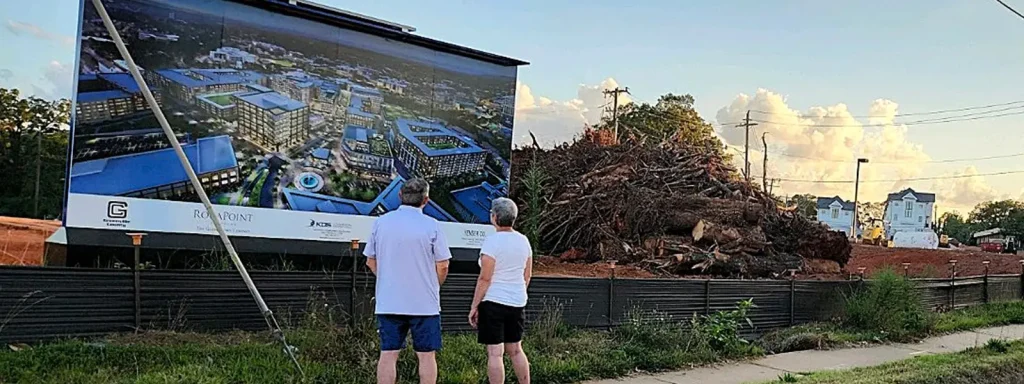
After 3 decades of preserving 1 million trees in the Upstate, it was time to come out of the trenches and share what we had learned. Despite battling illness through the long, hot summer, interviewing many people, and taking countless photos, I met an educated couple admiring Greenville’s proposed development as the sun set. I remarked, “There’s something missing.”
Upon becoming stumped with my assertion, I directed their attention to the right of the billboard. The husband quipped, “You mean those brown clumps?” I stated, “Those ‘brown clumps’ are trees; the remnants of an urban forest.” This development includes no “trees.” They bulldozed them all away! The wife countered, “The billboard has trees.” But according to Clemson University, a woody plant must grow to 15 feet to be classified as a tree.
Since the average floor height of an office building is 10 – 14 feet, and these plants do not appear to reach the second floor, they are likely ‘bushes.’ Even medium-sized trees would rival many of these buildings. What remains is metal, glass, concrete, and an artist’s few patches of green. But no trees! No shade for our dwellings. No filters for our air. No sponges for our stormwater. No retaining of our soil. No lodging for our wildlife. No relief from our stress. No bonding for our community.
Across the Upstate and the continent, we are rapidly replacing our large urban trees with meager, short-lived facsimiles. Planting trees for the next generation is noble. But what about the world we live in now? Small trees do not replace the many benefits of large, mature trees which take decades to grow. Parks are crowded and far away. If an enlightened couple can miss the “trees for the bushes,” what hope remains for the rest of us? Bushes make poor shade trees. Large trees take a generation to grow.
The Green Line – a watch group seeking tax-exempt status – aims to preserve our urban forest canopy by defining the rapidly retreating, line of demarcation between our vanishing remnant forest and the advancing, unchecked urbanization. We can choose to dwell in cool remnant forests and lush riparian zones. But we must act now! Find out how you can help. Randy Cyr, the Green Tree Doctor.